

Do security simulations and automat
What if your wallet could show the exact token flows and fees of a transaction before you ever put your private key to work? That question sits at the heart of several misconceptions about modern browser wallets — and it’s exactly the capability Rabby emphasizes. For DeFi power users who routinely interact with many chains and complex contracts, “safety” is not a single feature; it’s the composition of detection, prevention, recoverability, and operational ergonomics. This piece unpacks how Rabby’s design choices — transaction simulation, pre-transaction risk scanning, automatic network switching, gas top-ups, and approval revocation — alter those trade-offs, where the protections stop, and what to watch next.
Short answer: Rabby recalibrates the locus of control from “blind trust” (sign then reveal) to informed signing, but it does not eliminate systemic risks like novel smart-contract exploits or phishing. Understanding the mechanism behind each feature is the best way to decide whether to install the extension and how to use it in a US-regulated environment where institutional concerns and compliance touchpoints increasingly matter.
How Rabby’s core mechanisms work — and why they matter
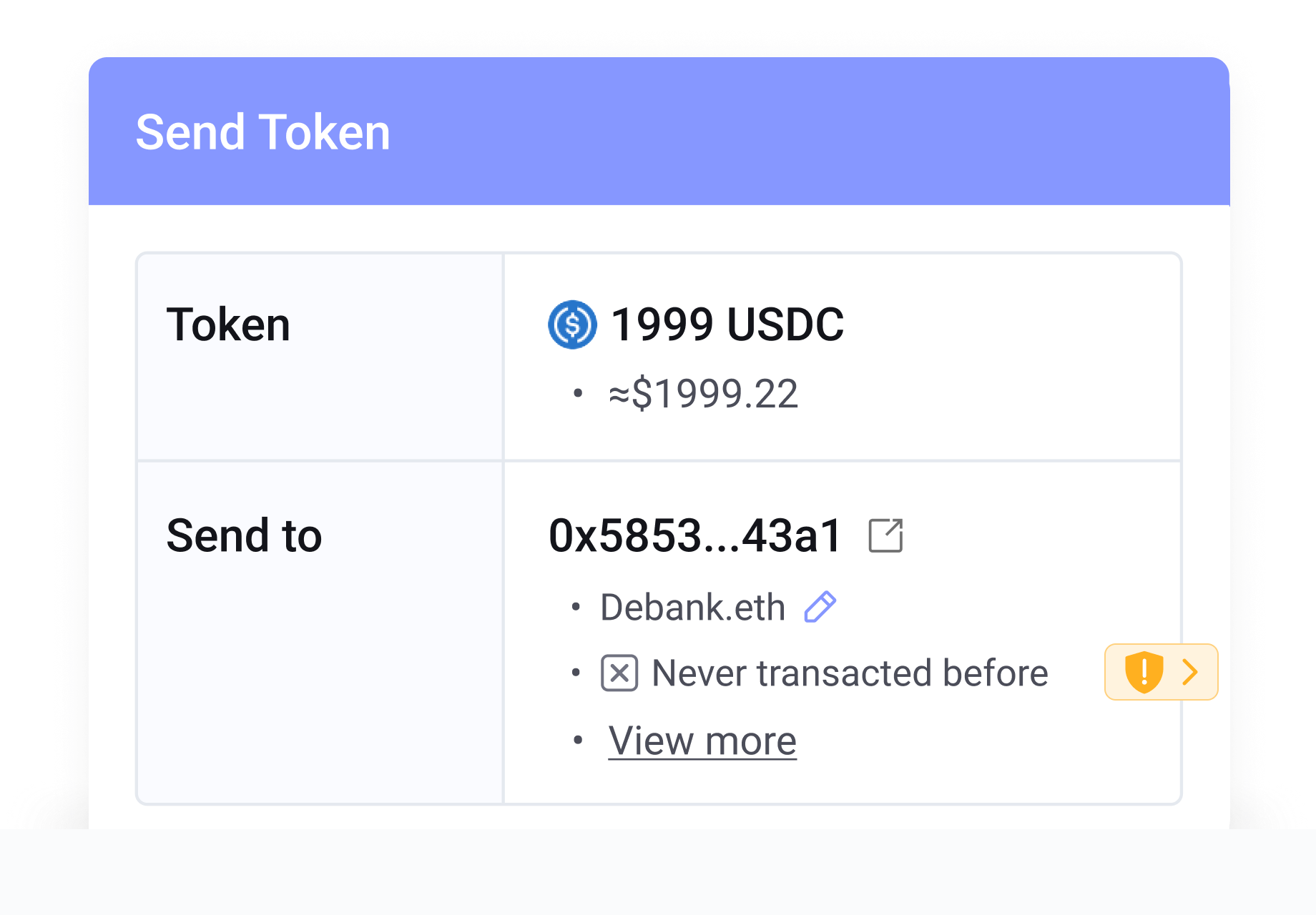
Rabby bundles several distinct mechanisms that matter practically for heavy DeFi workflows. First, transaction simulation: before you sign, Rabby executes a dry-run of the intended transaction against a node or local simulator to estimate token balance changes and gas costs. Mechanistically, that means the wallet inspects the low-level calldata and computes the post-execution balances you would see, converting an abstract approval or swap call into concrete, human-decipherable outcomes. For power users who batch swaps, route through DEX aggregators, or interact with vaults, that reduces the cognitive gap between “what the contract call looks like” and “what my balances will be.”
Second, pre-transaction risk scanning layers on smart-pattern detection: previously exploited contract addresses, unusually broad approval requests (infinite approvals), and non-existent recipient addresses are flagged. This is not mystical — it’s pattern recognition and blacklist/heuristic checking — but paired with transaction simulation, it changes signing from a binary yes/no into an informed choice of trade-offs. Third, automatic network switching removes a major UX failure mode: clicking a dApp that runs on Arbitrum while your wallet is on Ethereum mainnet. That one small ergonomic fix reduces failed transactions and accidental signing on the wrong chain, a surprisingly common source of user error.
Misconceptions and what’s actually true
Myth: “If a wallet simulates transactions and flags risks, I can’t lose funds.” False. Simulation helps prevent many user errors and some stealthy permission traps, but it cannot predict zero-day vulnerabilities in a contract’s internal logic, miner/executor front-running outside your control, or server-side phishing that steals your seed phrase. The 2022 Rabby Swap incident — an exploited smart contract with roughly $190,000 lost — illustrates that even teams responsive after an incident cannot retroactively immunize every future attack. What changed then was process: the team froze the faulty contract, compensated affected users, and heightened audits. Those are strong signals of responsible response, not proof of invulnerability.
Myth: “Automatic switching and simulation are just UX bells.” Not true for frequent multi-chain traders. Automatic network switching is a risk-reduction feature: when you sign a contract on a different network by mistake, funds can be lost or approvals misapplied. Transaction simulation, by translating abstract calldata into precise token deltas, prevents a class of “blind signing” attacks where malicious dApps request permissions that look innocuous but functionally wipe balances. In other words, these features shift risk from invisible protocol-level failure to observable, inspectable outcomes — a profound change in where the user can intervene.
Trade-offs, limits, and operational guidance
No wallet is perfect; each design choice brings trade-offs. Rabby’s open-source MIT-licensed codebase enables third-party audits and community scrutiny — a clear advantage for transparency. But open source is not the same as audited-by-all; audits are snapshots, not guarantees. Rabby also lacks a built-in fiat on-ramp and native staking within the wallet. For US users who prefer buying crypto directly via ACH or credit card inside their wallet, that missing feature means an external exchange or on-ramp service is still necessary, which increases lifecycle steps and potential custody transitions.
Another limit: transaction simulation relies on accurate node state and deterministic contract behavior. Complex contracts with off-chain oracles, asynchronous callbacks, or randomized internal logic can still produce different outcomes when executed live. Cross-chain gas top-up is a pragmatic operational feature — it reduces the friction of staking or interacting on a network with zero native gas — but it does not eliminate cross-chain bridge risk or the economic cost of multiple token conversions.
Practical guidance for DeFi power users:
- Use simulation as a verification step, not a substitute for on-chain reasoning. When a simulation shows unexpected balance flows, pause and inspect calldata or the target contract on a block explorer.
- Combine Rabby’s approval revocation tool with periodic audits of allowances, especially after interacting with AMMs or yield aggregators. This reduces long-tail exposure to approvals you granted months ago.
- For large or institutional flows, integrate hardware wallets (Ledger, Trezor, Keystone) and, where appropriate, multi-sig solutions supported by Rabby (Gnosis Safe, Fireblocks). Non-custodial convenience should never replace multi-sig for treasury size assets.
Comparative frame: where Rabby sits in the wallet landscape
Against well-known alternatives like MetaMask, Trust Wallet, and Coinbase Wallet, Rabby’s distinguishing emphasis is security-by-visibility: simulation and pre-signing scans. MetaMask pioneered the browser-wallet form factor and enjoys broad dApp compatibility; Rabby competes by reducing common human failure modes. For a US-based DeFi professional, the practical calculus is: do you value the additional decision-quality Rabby provides enough to adopt a different UX and workflow? If you rely heavily on multi-chain strategies and complex approvals, Rabby’s features are decision-useful. If you need an integrated fiat on-ramp or native staking inside the wallet, you will still need other services.
Institutionally, Rabby’s integrations with multi-signature and enterprise custody providers make it more palatable for teams and funds that require custodial controls and audit trails. That institutional support is a necessary condition for wider adoption in regulated US markets; it’s not sufficient by itself, because institutional adoption also depends on compliance tooling, KYC/AML links, and legal clarity around non-custodial interactions.
What to watch next — signals that would change the assessment
Watch for three developments. First, native fiat on-ramps inside Rabby would materially reduce transactional friction and custody transitions; that would lower the operational surface area where users move assets between services. Second, continued hardening against contract-level exploits — more frequent external audits, bug-bounty increases, and formal verification on components that touch funds — would improve trust but must be measurable (audit scope, remediation timelines). Third, improvements in simulation fidelity: if Rabby integrates richer on-chain or off-chain oracle state in its dry-runs, the accuracy of pre-sign simulations would climb, shrinking the gap between simulated and live outcomes.
Absent these changes, Rabby’s current value proposition remains tightly focused: reduce human error and make signing decisions more transparent. For US DeFi users who trade across L2s, arbitrum, Optimism, Polygon, and dozens of EVM chains, that can be a decisive advantage; for casual users who value one-click buys or staking-as-a-service, the niche fit is weaker.
How to get started and a practical checklist
If you want to experiment without replacing your primary wallet workflow, Rabby supports wallet importing by seed phrase or private key and offers a Flip toggle to toggle between Rabby and MetaMask as the default extension. That makes a low-friction transition possible for power users who want to compare signing behavior. The wallet is available across Chromium-based browsers and as mobile and desktop clients, so you can test its behavior in the environments you actually use.
Install checklist for a cautious DeFi pro:
- Install Rabby and link a hardware wallet; never import a mainnet seed phrase into an unknown extension.
- Practice small-value transactions to observe simulation outputs and the approval revocation workflow.
- Use the revocation tool immediately after any DEX or aggregator interaction to limit allowance exposure.
- Keep a separate “hot” wallet for daily operations and a cold/multi-sig setup for larger holdings; Rabby supports the enterprise integrations necessary for this split.
FAQ
Does Rabby prevent all smart-contract exploits?
No. Rabby materially reduces user-facing risks like blind signing and excessive approvals through transaction simulation and risk scans, but it cannot prevent novel contract-level vulnerabilities, unpredictable oracle failures, or social-engineering attacks that compromise keys. Simulations and scans are defensive controls, not absolute guarantees.
Can I buy crypto inside Rabby with a US bank card?
Not natively. Rabby does not currently include a built-in fiat on-ramp. US users must purchase on an exchange or on-ramp service and move funds into the wallet. This design reduces regulatory complexity inside the wallet but increases the number of custody transitions a user must manage.
How reliable are the transaction simulations?
Simulations are generally reliable for deterministic contract calls that depend only on on-chain state. They can be less reliable for contracts that use off-chain data, asynchronous callbacks, or non-deterministic randomness. Treat simulation output as a high-quality indicator, not an absolute prediction.
Can I use Rabby with a hardware wallet and multi-sig?
Yes. Rabby supports Ledger, Trezor, Keystone and others, and integrates with multi-sig and enterprise services like Gnosis Safe and Fireblocks. For significant balances, combining hardware keys with multi-sig is recommended.
For DeFi power users operating in the US, Rabby is worth testing as part of a layered-security strategy: it reduces human error and surface-level permission risk, but it must be paired with good key hygiene, hardware wallets, and institutional controls for larger holdings. If you want to try the extension and inspect how simulations change your signing decisions, the rabby wallet extension page is a practical place to begin.